Habe dazu noch einen kleinen Essay geschrieben.
Früher auf Kulturtechno: Radiobericht über mein Orchesterstück “-Bolero”

Habe dazu noch einen kleinen Essay geschrieben.
Früher auf Kulturtechno: Radiobericht über mein Orchesterstück “-Bolero”
Vor zwei Jahren fand in Harvard die Konferenz „New Perspectives on New Music“ statt, bei der, zusammenfassend gesagt, Hannes Seidl die Diesseitigkeit, meiner einer den Neuen Konzeptualismus, Harry Lehmann die Gehaltsästhetische Wende und Michael Rebhahn seinen Vorschlag einer Trennung von Klassischer und Neuer Musik vorgestellt haben.
Jetzt hat dort so etwas wie die >Gegenkonferenz< stattgefunden, in der Claus-Steffen Mahnkopf seine Entourage um sich geschart hat. Diesem Bericht zufolge wurde also nach Kräften auf den Neuen Konzeptualismus eingedroschen.
More than two years in the making, the first part of the part of the conference (formally billed as “New Tendencies of Contemporary Music in Germany”) took place in the spring of 2013 with composers Johannes Kreidler and Hannes Seidl; musicologist Michael Rebhahn; and music philosopher Harry Lehmann invited from Germany to present their work. Of differing artistic and philosophical projects, the four are frequently understood, controversially, as advancing different types of musical postmodernism in historically modernist parts of the German contemporary music scene.
This past weekend saw the opposite, with composers Kai Johannes Polzhofer, Dániel Péter Bíro and Claus-Steffen Mahnkopf; sociologist Ferdinand Zehentreiter; and philosopher Gunnar Hindrichs invited to elaborate an opposing point of view.
[…]
Harvard PhD candidate and German-Austrian composer Kai Johannes Polzhofer followed Bíro’s presentation with an expansive lecture entitled “Music Without Content and Some Other Recent Confusions.” Deeply critical of the underpinnings of German New Conceptualism, Polzhofer’s polemics took aim at political music in Germany that Polzhofer analyzed as qualified to call itself neither politics nor music. Identifying a pattern of careerism in the composers and theorists of the New Conceptualism, Polzhofer argued instead for a radically humanized approach to composition that Polzhofer would position as the foundation of a truly political music able to change the individual and society.
Das hört sich ganz nach einer Wiederauflage der Diskussion von Darmstadt letztes Jahr an, mit dem Unterschied, dass man die andere Seite jetzt draußen ließ und lieber in Abwesenheit verurteilte. Das überrascht nicht, war doch in Darmstadt die Niveaulosigkeit der Argumentation erschreckend – da weiß man sich nur noch durch Abschottung zu retten.

Neues aus der Forschung: Mit Bassfrequenzen kann man Feuer löschen. Ich komponier dann mal was für die Feuerwehr.
The fire extinguisher uses low-frequency sound waves to douse a blaze. Engineering seniors Viet Tran and Seth Robertson now hold a preliminary patent application for their potentially revolutionizing device.
(via kfmw)
Ich hatte hier mal Niclas Thobabens Konzept der „Deaftapes“ – man soll einen Remix aus 5 Samples am Computer erstellen, ohne dabei reinzuhören.
Hier nun Dubstep-Produzent seamlessR, der einen ganzen Track bastelt ohne zuzuhören.
Vielleicht sollte man den Track am Ende einfach löschen, auf dass ihn nie jemand gehört haben wird.
(via klang: teppich)
Heute: Dudelsackspieler
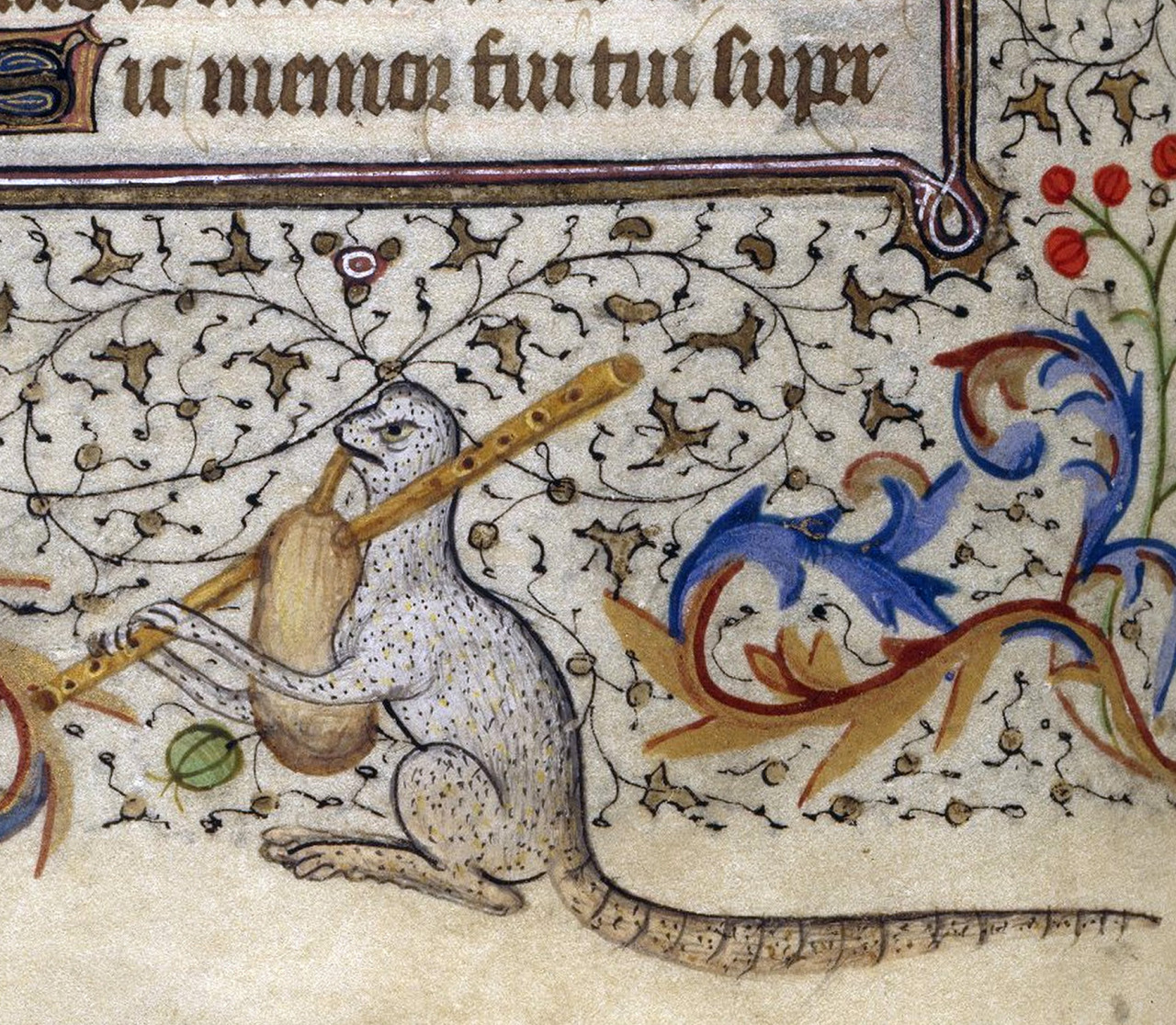
book of hours, France 15th century
Manchester, John Rylands University Library, Latin MS 162, fol. 169v

book of hours, Paris ca. 1460.
NY, Morgan Library & Museum, MS M.282, fol. 133v
(via discarding images / discarding images)
Früher auf Kulturtechno:
Musizierende Tiere (im Mittelalter)
Musizierende Tiere (im Mittelalter) (2)
Musizierende Tiere (im Mittelalter) (3)
Musizierende Tiere (im Mittelalter) (4)
Musizierende Tiere (im Mittelalter) (5)
Musizierende Tiere (im Mittelalter) (6)
Hatte hier unlängst wieder mal die Schreibmaschine als Instrument.
Wäre doch eigentlich ne passende Sache, dann ein Exemplar einer Notenschreibmaschine dafür zu verwenden. Gebt mir so ein Ding. Man hackt drauf rum, die enstehenden Noten sind dann die Partitur für das nächste Stück auf diesem Ding. ad infinitum. Wobei, es kommt dann ja immer das selbe Musikstück bei raus. Denkt euch eine störende Variable dazu.


The Keaton Music Typewriter was first patented in 1936 (14 keys) by Robert H. Keaton from San Francisco, California. Another patent was taken out in 1953 (33 keys) which included improvements to the machine. The machine types on a sheet of paper lying flat under the typing mechanism. There are several Keaton music typewriters thought to be in existence in museums and private collections. It was marketed in the 1950s and sold for around $225. The typewriter made it easier for publishers, educators, and other musicians to produce music copies in quantity. Composers, however, preferred to write the music out by hand.
(via colossal)
Alvin Luciers Klassiker, diesmal auf Instagram angewendet:
Künstler und Tüftler Pete Ashton aka Art Pete hat die digitale Kompression getestet indem das selbe Foto 90 mal hintereinander auf seinen Instgram-Account lud, einen Screenshot machte und diesen wieder hochlud.

(via kfmw)
Früher auf Kulturtechno:
I am sitting in YouTube
Kompressionstod
People listening to a phonograph with for the first time during a cattle show in Tonstad, Norway, c. 1890's. pic.twitter.com/lEJuhkje2q
— Old Pics Archive (@oldpicsarchive) 10. März 2015
Content: Tone; male voice saying: “One, two, three, four, five, six”; two more tones
Inscription: “Exp. III Nov. 17 1884/Style vibrations to word/ Barometer/H. G. Rogers”
Content: male voice saying: “ba-ro-me-ter”; each syllable is distinct and the word is
Content: male voice saying names, recording date, “Mary had a little lamb” repeated twice
Content: male voice reciting opening lines of “To be, or not to be” soliloquy from Hamlet
Content: in two segments with a gap in between; first segment is a male voice reading a story. At 51.8 seconds the voice suddenly changes to a high pitched “child imitation.” In the second segment a man is reading from a description of a New Hampshire factory.
Content: Unidentified long passage
(via newsdesk)
Früher auf Kulturtechno: Die erste Klangaufzeichnung der Welt (1860)
Parallel zum Neuen Konzeptualismus in der Musik gibt es seit etwa einer Dekade im englischsprachigen Raum die Strömung des Conceptual Writing. Das kommt nicht von ungefähr, und es ist sehr interessant, die Parallelen zu beobachten. (Nächstes Jahr soll es mehrere Veranstaltungen in USA und Australien geben, die dann konzeptuelle Literatur und Musik zusammenbringen wollen.)
Der oben gestellten Frage haben sich in einer Umfrage mehrere einschlägige Schriftsteller gestellt.
In 1959, Brion Gysin said that writing was fifty years behind painting. And it still is. So if conceptual art happened fifty years ago, we’re just beginning to get around to it now. These are ideas that have never been explored in poetry. We’ve had a little bit of pastiche, a little bit of — you know, a line from here, a line from there. But we’ve never had the concept of lifting something that you didn’t write and moving it over five inches, saying that it’s yours, and claiming that it’s a newly authored text.
[…]
I think that writers often try too hard in the name of expression, when often it’s just a matter of reframing what’s around you or republishing a preexisting text into a new environment that makes for a successful work. Of course this is nothing new: think of John Cage’s notion of silence or Duchamp’s urinal. But when it comes to writing, these approaches have rarely been investigated.
http://jacket2.org/commentary/what-relationship-between-conceptual-art-and-conceptual-writing
Danke für den Tipp, Seth.
