Selbstportrait: Pablo Garcia lässt eine Zeichenmaschine Zeichenmaschinen seit Dürer zeichnen.
(via exinfoam)

Selbstportrait: Pablo Garcia lässt eine Zeichenmaschine Zeichenmaschinen seit Dürer zeichnen.
(via exinfoam)
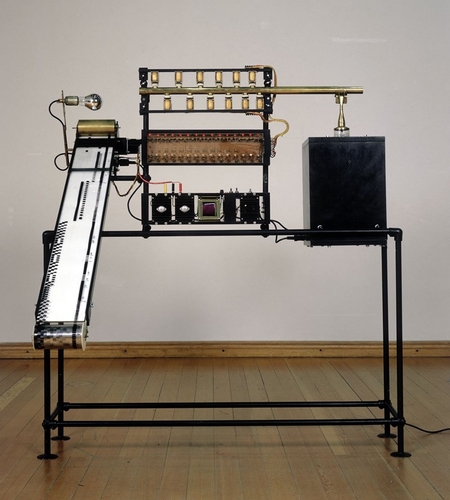
The Flute-playing Machine(1979-82)
Alto flute, range g to g‘, blower, electro-magnets, electronics.150cm high.On the right is the blower encased in its soundproof black box. On top of it is a valve that admits the air into the mouth piece of the flute. The horizontal brass tube is an especially made alto flute with a range of g to g‘. It is fitted with 12 electro-magnetic keys corresponding to the fingers of a human player. The diagonal slide on the right guides the music roll over a row of 15 photocells. Their signals are amplified by circuitry in the box below the flute and operate the keys and the air valve. The box below that contains the power supplies and the speed controller for the blower motor.
Martin Riches baut schon seit langem Instrumentenmaschinen (hier der Motormund). So sieht dann zB die Partitur für die Flötenmaschine aus, und darunter was dem in normaler Fünfliniennotation entspräche:
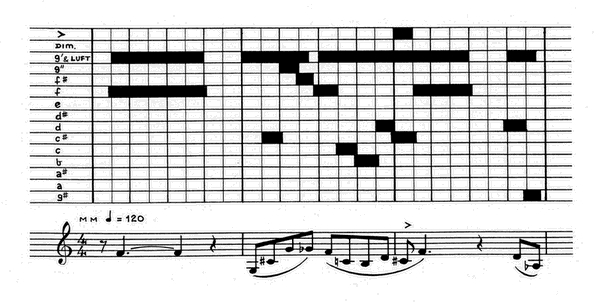
Leider habe ich kein Klangbeispiel gefunden. Es wäre ja sehr interessant, ob man damit, vergleichbar Conlon Nancarrows Studien für mechanisches Klavier, unspielbar virtuose Flötenmusik auf der Maschine spielen könnte (und dann ein Duo für Player Flute und Player Piano).
Ein wahrhaft „stilles Örtchen“: Der echolose Raum in den Orfield Laboratories, South Minneapolis.

Photo: Steven Orfield/Orfield Labs
If you think that loud noises drive you mad, try this quiet room for a change.
The anechoic chamber at Orfield Laboratories in South Minneapolis, certified as the quietest place on Earth by the Guinness World Records, is so quiet that the longest anyone has survived being in there is just 45 minutes:
‘When it’s quiet, ears will adapt. The quieter the room, the more things you hear. You’ll hear your heart beating, sometimes you can hear your lungs, hear your stomach gurgling loudly.
‘In the anechoic chamber, you become the sound.’
And this is a very disorientating experience. Mr Orfield explained that it’s so disconcerting that sitting down is a must.
He said: ‘How you orient yourself is through sounds you hear when you walk. In the anechnoic chamber, you don’t have any cues. You take away the perceptual cues that allow you to balance and manoeuvre. If you’re in there for half an hour, you have to be in a chair.’
Erst Recht Horror wäre dieser Raum für Tinnitusgeplagte (wie mich). Da sag noch einer „Musik als existenzielle Erfahrung“!
(via Neatorama)

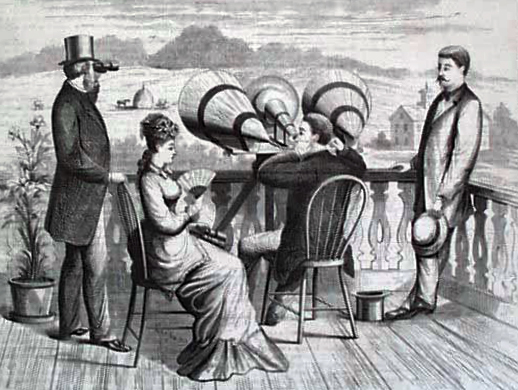
Unbekannter Maler: „Grammophonkonzert im Beethovensaal“ (1889) (Ausschnitt).
Das Original liegt nicht vor, eine Reproduktion stammt aus dem Bildarchiv Marburg. Abgedruckt in: Musik-Konzepte XI/2008, S. 182.
Das Bild war ironisch gemeint, es sollte die Anti-Utopie von Lautsprechermusik im Konzertsaal darstellen.
Noch bevor die Schreibmaschine ihren Durchbruch hatte, benutzte Friedrich Nietzsche bereits eine Zeitlang eine.
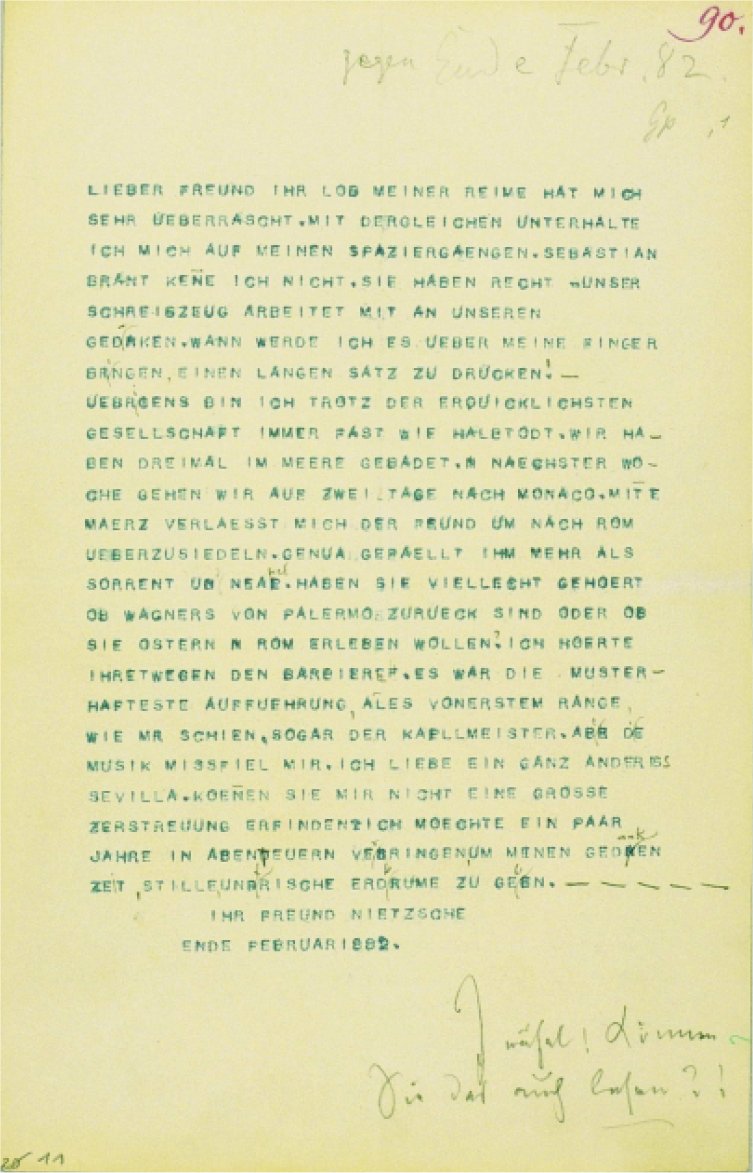
„Unser Schreibzeug arbeitet mit an unseren Gedanken.“
(vgl. ICH SCHREIB NICHT MIT DER HAND ALLEIN, / DER FUSS WILL STETS MIT SCHREIBER SEIN – / FEST FREI UND TAPFER LAEUFT ER MIR / BALD DURCH DAS FELD BALD DURCHS PAPIER.“)
Und der berühmte „Freud’sche Vertipper“:

http://www.stephan-guenzel.de/Texte/Guenzel_Nietzsche-SM.pdf
Update: Frühe Ascii-Art (1948) – Dank an Anton!
Neue Technologien schaffen ganz neue Kompositionsfelder. In Zeiten des Schnurtelefons wäre man im Leben nicht darauf gekommen, sich Klingeltöne zu kaufen. Wenn des Elektroauto kommt, wird man sich Motorenimitate runterladen.
Ach, der Willie wieder mal, mit seiner aufgetunten Kiste. Ich denke, ich werde ihm zu Ostern ein besseres Sound-Update schenken. Sein Opel wird sich dann wie ein Porsche anhören. Obwohl die mittlerweile ganz schön hinterher sind bei Porsche, nachgemachte Klänge abzumahnen.
(via buzzriders)
Durch die Digitalisierung fühlt sich die Welt immer mehr wie eine Simulation oder ein Computerspiel an. Jeder wird sich schon mal beim Online-Banking gedacht haben, dass die Zahlen da doch nur Spielgeld sind. Jetzt gibt es Google Maps in der 8-Bit-Version. Putzig.

Ich fände es gut, wenn Online-Banking auch im 90er-Arcade-Stil gehalten würde.
(via Spreeblick)
Rumms! Schon wieder geht das Abendland mit Karacho unter, denn nun gibt es das singende Keyboard aus Japan. Mit etwas Übung kann man zweihändig sein tiefstes Inneres zum Ausdruck bringen.
(via publique)