A Series of Falls Down Familiar Stairs (or Using My Body to Trace the Incline), 2014
(via jogging)
Auf der Tellerkreppe stehen Scharnwilder, dass man nicht ferunter hallen soll !
— BulliTH (@BulliTH_) 4. Mai 2014

A Series of Falls Down Familiar Stairs (or Using My Body to Trace the Incline), 2014
(via jogging)
Auf der Tellerkreppe stehen Scharnwilder, dass man nicht ferunter hallen soll !
— BulliTH (@BulliTH_) 4. Mai 2014
Axel Loytved hat sämtliche Wörter aus seinem SMS-Speicher, die der Autokorrektur nicht bekannt sind (Abgleich mit dem PONS-Wörterbuch), als lyrisches Material zusammengestellt.

Axel Loytved: »what to say«
239 Seiten, perforiert
Textem Verlag, Hamburg 2012
(via taz)
Früher auf Kulturtechno: Domainnamen, die keiner haben will
Sag noch einer, das Kunstlied sei tot. Nick Collins hat ein Liederzyklus nach berühmten Code-Zeilen komponiert.

Lyrics from famous programs as follows. Code used in the hope that no one will mind. If there is a copyright issue for use of your program, get in touch.
1. Hello World in C.
2. Quine’s Paradox. Due to Willard Van Orman Quine
3. Python program for activities.
4. Quine in C. Aldo Cortesi
5. Recursive routine in Fortran 77. Andrew J. Miller
6. Quine in scheme.
7. forkbomb.pl. Alex McLean
http://community.dur.ac.uk/nick.collins/music/codesongs.pdf
http://community.dur.ac.uk/nick.collins/CodeSongs.html
Früher auf Kulturtechno: Songifications
Dave Soldier und Komar & Melamid haben in den 90ern nach Umfragen die unbeliebteste Musik geschaffen. Steht leider nicht online – vielleicht weil zu unbeliebt? Bei Ubu kann man’s anhören (danke, Samuel):
http://www.ubu.com/sound/komar.html
This survey confirms the hypothesis that today’s popular music indeed provides an accurate estimate of the wishes of the vox populi. The most favored ensemble, determined from a rating by participants of their favorite instruments in combination, comprises a moderately sized group (three to ten instruments) consisting of guitar, piano, saxophone, bass, drums, violin, cello, synthesizer, with low male and female vocals singing in rock/r&b style. The favorite lyrics narrate a love story, and the favorite listening circumstance is at home. The only feature in lyric subjects that occurs in both most wanted and unwanted categories is “intellectual stimulation.” Most participants desire music of moderate duration (approximately 5 minutes), moderate pitch range, moderate tempo, and moderate to loud volume, and display a profound dislike of the alternatives. If the survey provides an accurate analysis of these factors for the population, and assuming that the preference for each factor follows a Gaussian (i.e. bell-curve) distribution, the combination of these qualities, even to the point of sensory overload and stylistic discohesion, will result in a musical work that will be unavoidably and uncontrollably “liked” by 72 plus or minus 12% (standard deviation; Kolmogorov-Smirnov statistic) of listeners.
The most unwanted music is over 25 minutes long, veers wildly between loud and quiet sections, between fast and slow tempos, and features timbres of extremely high and low pitch, with each dichotomy presented in abrupt transition. The most unwanted orchestra was determined to be large, and features the accordion and bagpipe (which tie at 13% as the most unwanted instrument), banjo, flute, tuba, harp, organ, synthesizer (the only instrument that appears in both the most wanted and most unwanted ensembles). An operatic soprano raps and sings atonal music, advertising jingles, political slogans, and “elevator” music, and a children’s choir sings jingles and holiday songs. The most unwanted subjects for lyrics are cowboys and holidays, and the most unwanted listening circumstances are involuntary exposure to commericals and elevator music. Therefore, it can be shown that if there is no covariance—someone who dislikes bagpipes is as likely to hate elevator music as someone who despises the organ, for example—fewer than 200 individuals of the world’s total population would enjoy this piece.
http://awp.diaart.org/km/musiccd.html
Update: Es hat sich auch ein Video gefunden (Danke Jenny!):
Aus der aktuellen Keyboardliteratur zwei bemerkenswerte Stücke:
Henrique Vaz: Black MIDI (2013)
Duo piece for Piano + Dispositive (eccentric rotating mass vibrating motors – amplitude: from 6G to 13G} & MIDI Keyboard.Piano & MIDI Keyboard: Henrique Vaz
Anton Wassiljew – Keyboardstück III (2011-2014)
Keyboard, Sebastian Berweck
14.04.2014 Konzertsaal der Hochschule für Künste Bremen
Das nächste Re-enactment (könnte man auch ein ganzes Online-Festival draus machen):
Trevor Cox hat Alvin Lucies Klassiker I am sitting in a room in dem Raum mit dem mutmaßlich längsten Nachhall realisiert.
A rendition of Alvin Lucier’s I am Sitting in a Room played using the Inchindown Oil Tanks that hold the Guinness World Record for having the ‚longest echo‘. The text passes through the oil tanks multiple times, until all that remains are strange tones created by this long feedback loop. The immense reverberance of the oil tanks give a very different feel to the early evolving sound compared to renditions using more conventional concert halls.
Umgekehrt wär’s auch interessant, das Stück in einem maximal schallschluckenden Raum aufzuführen.
(via Disquiet)
Schönes Re-Enactment von György Ligetis „Poème Symphonique“ für 100 Metronome – so wie ich es verstehe haben Paul Hübner und Niklas Seidl YouTube-Filme mit Metronomen genommen und als Split Screen angeordnet, wobei aus den verschiedenen Dauern der vorgefundenen Filme der Ausdünnungsprozess resultiert, der bei Ligeti durch sukzessives Ausscheiden der entspannten Metronomfedern entsteht.
by David Pocknee
for Andy Ingamells
…
13718 verbs re-imagined as Fluxus one-word text scores, arranged in a random order that will change when the page is refreshed.
Some verbs appear in both English and American spellings. These small differences should indicate a subtle change in the approach to performance.
…
ANDY (leafing through Yoko Ono’s „Grapefruit“): A lot of these scores seem like you just take a random word from the dictionary, stick „PIECE“ on the end of it and then the piece is just that word with a full stop after it and the date…
DAVID AND ANDY: …wait a minute…
…
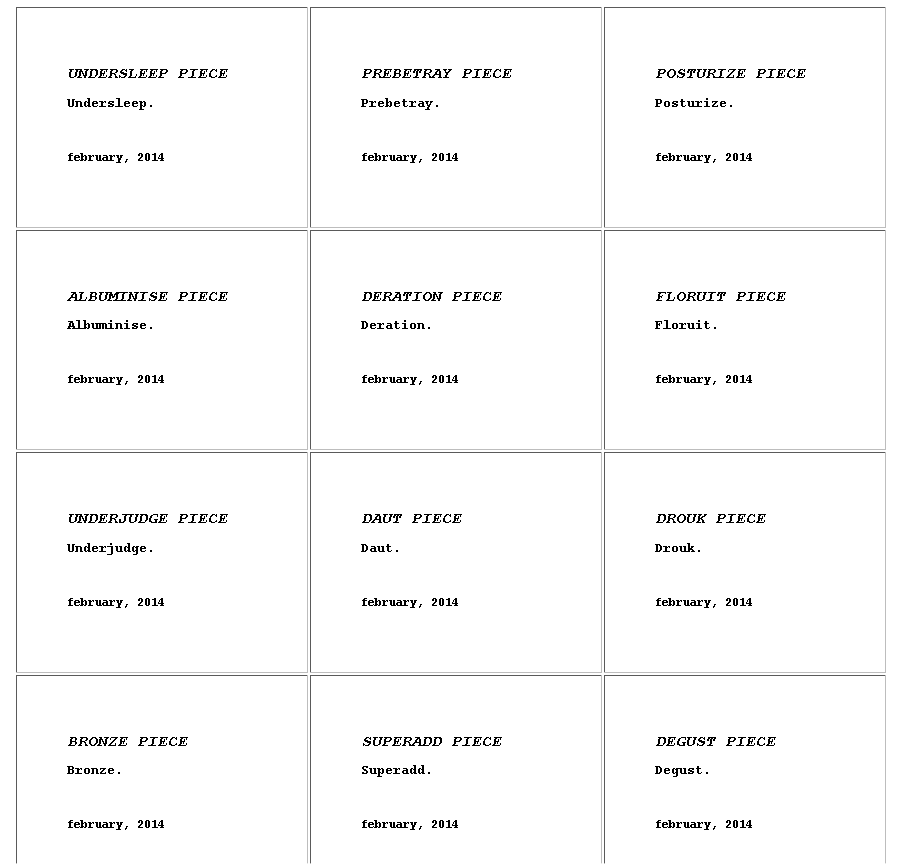
(via textscoreaday)
Wer sich für den amerikanischen Abstraktminimalisten interessiert, hier gibt’s eine hervorragende Ressource:
http://www.cnvill.net/mftexts.htm
(via Ali)
