

‘238 francs and 30 cents’, 1994,
10 centimes coins, 330 x ø 2 cm.
Exhibition view ‘Presque Rien’, galerie Jennifer Flay, Paris. 11 June – 13 July 1994. Curated by Jennifer Flay.

‘238 francs and 30 cents’, 1994,
10 centimes coins, 330 x ø 2 cm.
Exhibition view ‘Presque Rien’, galerie Jennifer Flay, Paris. 11 June – 13 July 1994. Curated by Jennifer Flay.
![Claude Closky, ‘Carré préféré [favorite square]’, 1993, ballpoint pen on grid paper, 30 x 24 cm.](http://www.closky.info/images/Closky_Carre_prefere.jpg "Claude Closky, ‘Carré préféré [favorite square]’, 1993, ballpoint pen on grid paper, 30 x 24 cm.")
‘Carré préféré [favorite square]’, 1993,
ballpoint pen on grid paper, 30 x 24 cm.

‘+ 0,04978 %’, 2009,
2010 greeting card. Caen: Basse-Normandie Fonds National d’Art Contemporain, 18,5 x 14,5 cm.
![Claude Closky, ‘8560 nombres qui ne servent pas à donner l’heure [8560 numbers which aren’t used to give time]’, 1994, Genève: Centre d’édition contemporaine, 80 volumes, 21 x 15 cm, 214 pages each. Exhibition view Centre d’édition contemporaine, Genève. 19 May - 9 July 1994. Curated by Véronique Bacchetta](http://www.closky.info/images/Closky_8560_nombres_CEC.jpg "Claude Closky, ‘8560 nombres qui ne servent pas à donner l’heure [8560 numbers which aren’t used to give time]’, 1994, Genève: Centre d’édition contemporaine, 80 volumes, 21 x 15 cm, 214 pages each. Exhibition view Centre d’édition contemporaine, Genève. 19 May - 9 July 1994. Curated by Véronique Bacchetta")
‘8560 nombres qui ne servent pas à donner l’heure [8560 numbers which aren’t used to give time]’, 1994,
Genève: Centre d’édition contemporaine, 80 volumes, 21 x 15 cm, 214 pages each.
Exhibition view Centre d’édition contemporaine, Genève. 19 May – 9 July 1994. Curated by Véronique Bacchetta.
http://ww.closky.info/?p=807
Der Konzeptkünstler Claude Closky, man könnte ihn einen französischen Timm Ulrichs nennen, macht schöne Arbeiten, die sich wunderbar im Netz zeigen lassen. Seine Website ist ein Parcours, ich bringe hier in den nächsten Tagen eine persönliche Auswahl.
Leider ist es schwierig bis unmöglich, die Fotos hier einzubinden. Auch wenn es nur fehlerhaft geht, mach ich jetzt trotzdem. Sonst klickt auf den Link drunter.


‘From 1 to 100’, 1993,
mixed media, 70 x 1500 x 15 cm.
‘Heather Allen, Claude Closky, Roland Moreau’, Ecole Supérieur d’Art du Havre (ESAH), Le Havre. 12 May – 5 June 2000. Curated by Pierre Guislain.
http://ww.closky.info/?p=326
Auf der englischen Wikipedia gibt es interessante Listen von musikalischen Spezialfällen:
http://en.wikipedia.org/wiki/List_of_music_considered_the_worst
http://en.wikipedia.org/wiki/List_of_songs_considered_the_best
http://en.wikipedia.org/wiki/List_of_controversial_album_art
http://en.wikipedia.org/wiki/List_of_silent_musical_compositions
http://en.wikipedia.org/wiki/List_of_songs_about_bicycles
http://en.wikipedia.org/wiki/List_of_songs_about_or_referencing_Elvis_Presley
(via Klangteppich)
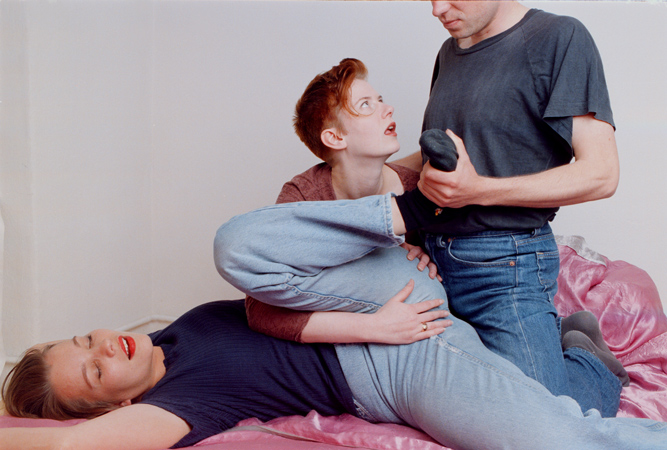


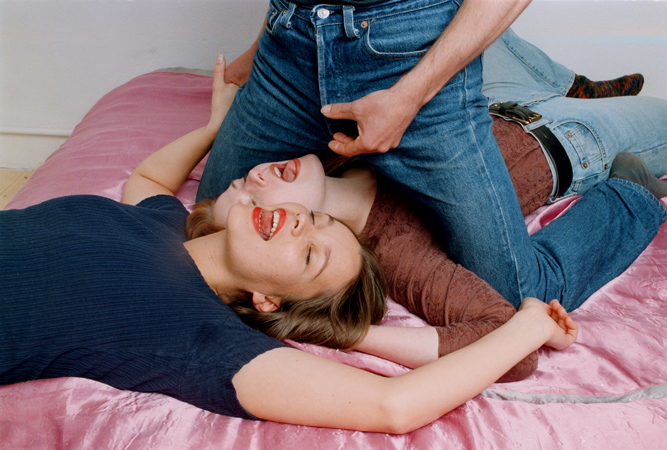
„sweet little sixteen“ (1996) von Beate Geissel und Oliver Sann, die auch viele andere tolle Fotoarbeiten machen.
Früher auf Kulturtechno: Porn for the Blind.
Eine sehr schönes Feature auf Deutschlandradio Kultur von Hannes Seidl.
Mit Beginn des digitalen Zeitalters löste sich der Klang vom Trägermaterial und der Eroberungsfeldzug der mp3s begann. Der Algorithmus basiert auf den Erkenntnissen der Psychoakustik: Signalanteile, die der Mensch nicht zu hören vermag, werden entfernt.
Bis heute steht das Format für Kompressionsraten ohne hörbaren Qualitätsverlust. In Zusammenarbeit mit dem Experimentalstudio des SWR entwickelte der Komponist und Klangkünstler Hannes Seidl einen invertierten mp3-Filter, der den Abfall der digitalen Wegwerfgesellschaft freilegt. Dieser ist wider Erwarten kein stiller Zeitgenosse.
Seit März 2013 sendet Deutschlandradio Kultur Hannes Seidls „Leftovers“ in der Reihe „Sonarisationen“. Nun erläutert der Komponist die Hintergründe seiner Arbeit.
Produktion: DKultur 2014
Länge: ca. 50’ 00Hannes Seidl, geboren 1977 in Bremen, lebt als Komponist für Neue Musik in Frankfurt am Main. Seine Arbeiten waren u.a. auf der Biennale in Venedig, dem Ultraschall-Festival in Berlin und im ZKM Karlsruhe zu hören. Zuletzt für DKultur: „Studio“ (2013).
http://www.deutschlandradiokultur.de/leftovers.1022.de.html?dram:article_id=281159
Hannes Seidls Orchesterstück „Mehr als die Hälfte“, das eine invertierte Mp3-Kompression anwendet:
https://soundcloud.com/hgs/mehr-als-die-halfte
ich habe auch schon 2008 die Idee des invertierten Mp3-Codecs geäußert:
Als nächstes komme ich mit einem leeren Laster und reiche ein symbolisches Nichts ein, meine Musik ist nun geläutert und rein, nur von mir und niemandem sonst. Ich habe mir schon einen Decoder dafür programmiert, „3pm“, die Umkehrung von „mp3“, mit dem nicht die unhörbaren Frequenzen entfernt werden, sondern die hörbaren. Das wäre die Lösung.
