
Selbstreferentielle Baustelle

Ein Künstler, dessen Name ich gerade nicht parat habe, hatte mal das Konzept, dass er im Ausstellungsraum einen Schaden von genau der Größe anrichtet, dessen Instandsetzung das Projektbudget verzehrt.
(aus den Tumblr-Weiten)
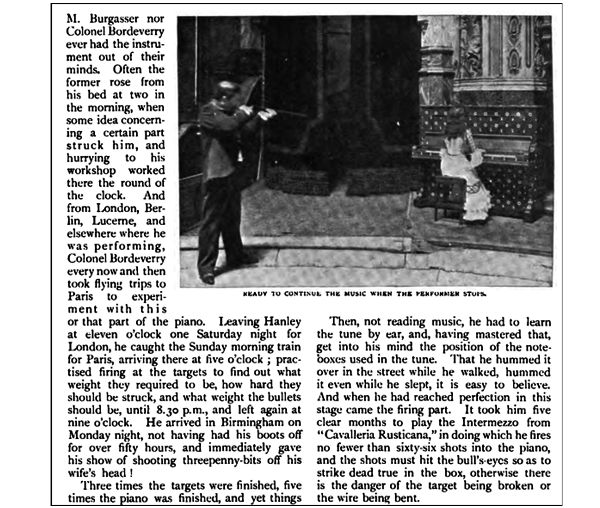
Klavier mit Gewehr spielen
Colonel Gaston Bordeverry hat’s getan, 1904.
Special bullets are used, it may be mentioned, and here again the colonel brought his genius into play. They had to be noiseless when they struck the box, and the report of the rifle and the smoke from the discharge of it had to be done away with. So Colonel Bordeverry prepared a special powderless bullet in which a secret chemical compound takes the place of the powder. With what force the projectile strikes the interior of the box may be gathered from the fact that it ploughs its way easily through a one inch-thick plank.
One of our photographs shows Miss Bordeverry seated at the piano playing, her father being behind ready to take up the tune the moment she ceases. This is done to demonstrate the remarkable fact that it can be used even as an ordinary piano and that it is a piano in every sense of the word.
Musizierende Tiere (im Mittelalter)(30)

harping hare
‘The Maastricht Hours’, Liège 14th century
BL, Stowe 17, fol. 92v

rabbit knight
Macclesfield Psalter, England ca. 1330-1340
Cambridge, Fitzwilliam Museum, MS 1-2005, fol. 115v
(via DiscardingImages / DiscardingImages)
Früher auf Kulturtechno:
Musizierende Tiere (im Mittelalter)
Musizierende Tiere (im Mittelalter) (2)
Musizierende Tiere (im Mittelalter) (3)
Musizierende Tiere (im Mittelalter) (4)
Musizierende Tiere (im Mittelalter) (5)
Musizierende Tiere (im Mittelalter) (6)
Musizierende Tiere (im Mittelalter) (7)
Musizierende Tiere (im Mittelalter) (8)
Musizierende Tiere (im Mittelalter) (9)
Musizierende Tiere (im Mittelalter) (10)
Musizierende Tiere (im Mittelalter) (11)
Musizierende Tiere (im Mittelalter) (12)
Musizierende Tiere (im Mittelalter) (13)
Musizierende Tiere (im Mittelalter) (14)
Musizierende Tiere (im Mittelalter) (15)
Musizierende Tiere (im Mittelalter) (16)
Musizierende Tiere (im Mittelalter) (17)
Musizierende Tiere (im Mittelalter) (18)
Musizierende Tiere (im Mittelalter) (19)
Musizierende Tiere (im Mittelalter) (20)
Musizierende Tiere (im Mittelalter) (21)
Musizierende Tiere (im Mittelalter) (22)
Musizierende Tiere (im Mittelalter) (23)
Musizierende Tiere (im Mittelalter) (24)
Musizierende Tiere (im Mittelalter) (25)
Musizierende Tiere (im Mittelalter) (26)
Musizierende Tiere (im Mittelalter) (27)
Musizierende Tiere (im Mittelalter) (28)
Musizierende Tiere (im Mittelalter) (29)
Martin Schüttlers Vortrag „Social echoes. Composing sonic identities.“
Ein schöner Vortrag in einer schönen (=weil videodokumentierten) Reihe.
Siehe beispielsweise auch die Vorträge von Sergej Newski, Klaus Lang oder Clemens Gadenstätter.
Ältestes Musikinstrument der Welt in schwäbischer Höhle entdeckt
So ähnlich lautete bei mir schon mal eine Überschrift. Jetzt haben sie dort halt noch eine ältere Flöte gefunden. Schwäbischer Erfindergeist hat Tradition.
Dafür jetzt was algorithmisches komponieren.
In einer Höhle der Schwäbischen Alb haben Archäologen ein rund 40.000 Jahre altes Flötenfragment entdeckt. Das Instrument besitzt zwei Ansätze für Grifflöcher und wurde aus einem Gänsegeier-Knochen geschnitzt.

(via scinexx)
All Star, sung notes are sorted by pitch, ascending
Sich noch mal fühlen wie im Konzeptualismus anno 2013.-
Danke für den Tipp, Jonathan!
Earjobs – Verdienen mit Hören; die Dokumentation
Passt zum Tag der Arbeit: Am 8./9. April habe ich im Haus der Kulturen der Welt beim Free!Music-Festival die Aktion „Earjobs“ durchgeführt. Menschen wurden fürs Hören von Musik bezahlt, und korrumpiert. (Kulturtechno früher)
Triggerwarnung: #Kapitalismus
Johannes Kreidler
Earjobs
Verdienen mit Hören
Der Künstler betreut zwei Tage lang eine Hörstation, bei der ein wechselndes Programm offeriert wird; 10 Titel, wovon 9 der Neuen Musik zugerechnet werden, und 1 Muzak-Titel. Nach dem Anhören eines Stücks bekommt der Hörer einen Geldbetrag ausbezahlt. Der Muzak-Titel wird weitaus besser bezahlt (ca. das 10fache) als alle anderen.
Die Preise berücksichtigen den gesetzlichen Mindestlohn – wer eine Stunde Hörarbeit verrichtet, wird auf mindestens 8,50€ kommen. Jede Bezahlung wird versteuert, Schwarzhören geht nicht! (Studierende bekommen nichts, sie gelten als Praktikanten. Kinder dürfen nicht teilnehmen, da das als Kinderarbeit gelten würde.)
Die Intervention thematisiert den Wert des Hörens von Musik, den Wert verschiedener Musiken, die Subventionierung von Musik, der Einfluss von Geld auf die Wahrnehmung.
Werbung für RSS-Feeds
Es wird Zeit, mal wieder auf RSS hinzuweisen. Leider hat sich immer noch nicht genügend herumgesprochen, dass es die wunderbare Einrichtung namens “RSS-Feeds” gibt; damit kann man Blogs und alle möglichen News-Webseiten abonnieren, Spiegel Online oder FAZ, Zeit.de oder Blogs wie Kulturtechno. Man braucht dafür einen RSS-Reader, ich verwende theoldreader.com; da kann man alle Blogs etc. eintragen, die man gerne lesen möchte, und ebenda dann alle deren neuen Beiträge wie in einer bunten Zeitung untereinander lesen, ohne kreuz und quer durchs Netz navigieren zu müssen und ohne was zu verpassen.
Um ein Blog zu abonnieren, klickt man in dem Reader links oben auf “Feed Abonnieren” und da gibt man dann die RSS-Adresse des Blogs ein. Diese Adresse findet sich bei vielen Blogs hinter diesem Icon (oder der Firefox Browser hat es selbst als Icon, das einem den nötigen Link besorgt):

Und so lautet die RSS-Adresse von Kulturtechno bspw.:
http://www.kulturtechno.de/?feed=rss2
Und wer auch die Kommentare alle im Reader lesen will, dann noch diese Adresse ebenfalls abonnieren:
http://www.kulturtechno.de/?feed=comments-rss2
Ich kann es allen nur empfehlen: Nutzt RSS-Feeds!
Siehe zu dem Thema auch:
Mein tägliches Festival
Mein Mediennutzungsverhalten