for Keyboard and Video (2016)
Karlsruhe, ZeitGenuss Festival 2019

for Keyboard and Video (2016)
Karlsruhe, ZeitGenuss Festival 2019
Jeffrey Brown hat es getan.
Domenico Scarlatti (1685–1757) wrote a lot of Sonatas. [559] Fair enough: what else was there to do all day before Twitter was invented? Listening to all these pieces in 2020 proved another challenge. I’ll make no claim to have heard each work in monkish concentration, and I make no guarantees for the correctness of my observations. But, at least partially thanks to the social wasteland caused by the coronavirus, I really did hear the entirety of every single one. Now you don’t have to.
For my sanity, I’ve ranked the works by category, instead of giving each Sonata a unique number. For your sanity, I haven’t described every piece—instead, I’ve only included my notes which either added to the description from the category or which I otherwise found interesting or funny. I’ve also included some miscellaneous pieces on this list, bringing the total from the standard 555 to 559. I mostly listened to the Scott Ross harpsichord recordings, though sometimes I also heard them on piano. (Sue me.)

(via Arno auf FB)
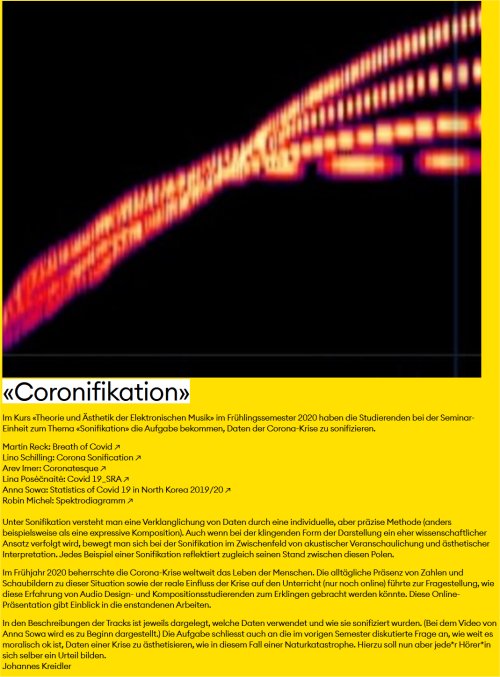
In the course «Theory and Aesthetics of Electronic Music» in spring semester 2020, in the lession «Sonification» the students were given the task to sonify data from the Corona Crisis.
Sonification means to be a sounding of data by an individual, but precise method (different for example from an expressive composition). Even if the sonic form of the representation follows a more scientific approach, sonification is situated in the intermediate field between acoustic illustration and aesthetic interpretation. Each example of sonification reflects at the same time its position between these poles.
In spring 2020, the Corona Crisis dominated people’s lives worldwide. The everyday presence of figures and diagrams on this situation and the real influence of the crisis on teaching (only online) led to the question of how this experience could be brought into sound by audio design and composition students. This online presentation gives an insight into the works that have been created.
In the descriptions of the tracks it is explained which data was used and how it was sonified. (In the case of the video by Anna Sowa it is shown at the beginning). The task also connects to the question discussed in the previous semester, to what extent it is morally ok to aestheticize data of a crisis, as in this case a natural disaster. For this, however, each listener should now make his or her own judgement.
Johannes Kreidler
Link: scroll down, it’s at the right
https://www.sonicspacebasel.ch/de/events-news.html
(See there also the very exciting seminar collection from Michel Roth’s course „Distand Musicking“.)
Ich freue mich, dass der Komponist Ui-Kyung Lee zwei Texte von mir ins Koreanische Übersetzt hat: Musik mit Musik und Präpariertes Hören.
예전부터 하려고 했었던 독일어와 영어의 현대음악 텍스트의 번역을 3월 중순부터 있었던 독일 전역의 lockdown을 통해 시간적 여유가 조금 생기게 되면서 드디어 하게 되었습니다. 번역전문가가 아니다 보니 시간이 정말로 많이 걸리긴 했지만, 베를린에서 음악학을 공부하고 있는 신문선Moonsun Shin 후배님의 감수와 교정으로 몇 개가 완성이 되어서 새로 만든 블로그를 통해 조금씩 공개하려고 합니다. 일단은 2010년부터 최근 사이에 쓰였던 텍스트들 중 현재까지 이론적으로나 실천적으로 중요하게 받아들여진 텍스트들을 선택해서 진행하고 있습니다.
https://blog.naver.com/uikyunglee_komp/221967750838
https://blog.naver.com/uikyunglee_komp/221967763170
Ebenso hat er Texte von Jennifer Walshe und Hannes Seidl übersetzt.
In den letzten Tagen war FaceApp wieder populär, diesmal mit der Funktion Gender Swap. Irgendjemand musste es natürlich tun:
(via Seth auf FB)
Vor zwei Jahren habe ich ein Stück uraufgeführt, das nur aus den Bewertungen von Fahrradklingeln auf Amazon kompiliert war.
Hier hat jemand Buchbewertungen durchgearbeitet.
(via Mario auf FB)

