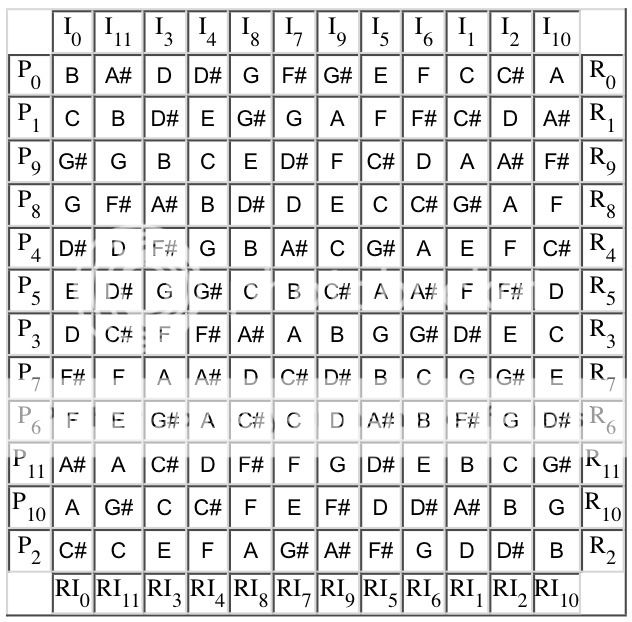
Aus einem Trichord eine Zwölftonreihe ableiten, wie weiland Webern, das macht man hier:
Und irgendwie macht mich Nerd das ein bisschen süchtig, ständig neue Reihen zusammenklicken. Ich sollte es zur Performance machen.

Aus einem Trichord eine Zwölftonreihe ableiten, wie weiland Webern, das macht man hier:
Und irgendwie macht mich Nerd das ein bisschen süchtig, ständig neue Reihen zusammenklicken. Ich sollte es zur Performance machen.
Da wird einem mal wieder deutlich, in was für einer Steinzeit man noch früher gelebt habt. In meiner Jugend hatte ich wirklich Mühe, Notenpapier zu bekommen, und im Musikalienfachgeschäft dann gab es dennoch nicht gerade viel Auswahl an Formaten.
Hier gibt es eine riesige Sammlung von pdfs in allen möglichen Formaten:
http://www.dolmetsch.com/manuscriptpaper.htm
Update: Oder hier kann man es sogar customizen (danke, Markus!).
…und das kommt auch noch von einer Verwendung als Waffe. Die Kittlerjugend ist aus dem Häuschen.
(via usernamealreadyexists)
Und hier noch ein Artikel über das (?) Phonotube, eine Erfindung von Graham Bell.
Schöne Darstellungsmethode.
In der Luxusversion mit Kokain. Music is the only drug.
(via socks-studio)
War eigentlich nur eine Frage der Zeit – sollte diese Technik auch für Neue Musik funktionsfähig sein, könnte es erneut eine kleine Medienrevolution des Komponierens auslösen.
StaffPad is a new pen-friendly music notation application for Windows 8.1 and Surface.
StaffPad features advanced handwriting recognition, and will convert your music into a typeset score. Simply write your music straight on to the screen, using your device’s pen. As you move from bar to bar, StaffPad will convert your handwriting into an ‘engraved’ score. You can draw notes, beams, stems, articulations, accidentals, slurs, ties and more.
The developers describe it as ‘the most natural way to write music on digital device, ever.‘
(via Synthopia)
Neues aus der Forschung: Mit Bassfrequenzen kann man Feuer löschen. Ich komponier dann mal was für die Feuerwehr.
The fire extinguisher uses low-frequency sound waves to douse a blaze. Engineering seniors Viet Tran and Seth Robertson now hold a preliminary patent application for their potentially revolutionizing device.
(via kfmw)
Hatte hier unlängst wieder mal die Schreibmaschine als Instrument.
Wäre doch eigentlich ne passende Sache, dann ein Exemplar einer Notenschreibmaschine dafür zu verwenden. Gebt mir so ein Ding. Man hackt drauf rum, die enstehenden Noten sind dann die Partitur für das nächste Stück auf diesem Ding. ad infinitum. Wobei, es kommt dann ja immer das selbe Musikstück bei raus. Denkt euch eine störende Variable dazu.
The Keaton Music Typewriter was first patented in 1936 (14 keys) by Robert H. Keaton from San Francisco, California. Another patent was taken out in 1953 (33 keys) which included improvements to the machine. The machine types on a sheet of paper lying flat under the typing mechanism. There are several Keaton music typewriters thought to be in existence in museums and private collections. It was marketed in the 1950s and sold for around $225. The typewriter made it easier for publishers, educators, and other musicians to produce music copies in quantity. Composers, however, preferred to write the music out by hand.
(via colossal)
Alvin Luciers Klassiker, diesmal auf Instagram angewendet:
Künstler und Tüftler Pete Ashton aka Art Pete hat die digitale Kompression getestet indem das selbe Foto 90 mal hintereinander auf seinen Instgram-Account lud, einen Screenshot machte und diesen wieder hochlud.
(via kfmw)
Früher auf Kulturtechno:
I am sitting in YouTube
Kompressionstod
People listening to a phonograph with for the first time during a cattle show in Tonstad, Norway, c. 1890's. pic.twitter.com/lEJuhkje2q
— Old Pics Archive (@oldpicsarchive) 10. März 2015
Content: Tone; male voice saying: “One, two, three, four, five, six”; two more tones
Inscription: “Exp. III Nov. 17 1884/Style vibrations to word/ Barometer/H. G. Rogers”
Content: male voice saying: “ba-ro-me-ter”; each syllable is distinct and the word is
Content: male voice saying names, recording date, “Mary had a little lamb” repeated twice
Content: male voice reciting opening lines of “To be, or not to be” soliloquy from Hamlet
Content: in two segments with a gap in between; first segment is a male voice reading a story. At 51.8 seconds the voice suddenly changes to a high pitched “child imitation.” In the second segment a man is reading from a description of a New Hampshire factory.
Content: Unidentified long passage
(via newsdesk)
Früher auf Kulturtechno: Die erste Klangaufzeichnung der Welt (1860)